

July 1st is National Financial Freedom Day!
It’s a great time to check on your progress toward financial independence, or FI – the ability to sustain your current (or desired) lifestyle, indefinitely, without additional earned income.
To commemorate the occasion, I wanted to toss out:
- Four ways to celebrate
- Three quotes to ponder
- Two questions to consider
- One (sobering) fact
Four Ways to Celebrate
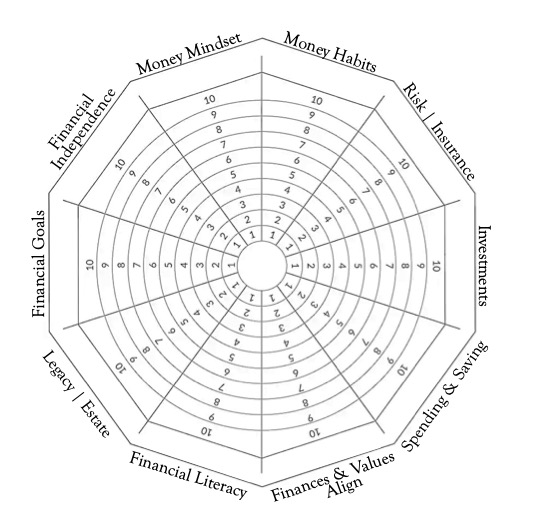
Fill out the Financial Wellness Wheel.
It provides a visual overview of your current financial situation and helps identify areas that require additional attention.
Do a Financial Behavior Reset
Write down a financial behavior for each of the five categories.
Keep the list somewhere you’ll see it throughout the day.

Cozy up with a Financial FreedOm Book
Read Happy Money Happy Life: A Multidimensional Approach to Health, Wealth, and Financial Freedom to discover the many ways money can be used to improve your wellbeing.
Find Your “Money Mindset” Tribe(s)
Facebook has a few wonderful communities for those who are working towards (or wondering about) financial freedom, including:
[FIRE] Financial Independence and Retire Early
Financial Freedom Quotes to Ponder
You own the things you own and they in turn own you. Money can buy many things, but nothing more valuable than your freedom.
Life choices are not always about the money, but you should always be clear about the financial impact of the choices you make.
J.L. Collins, author of
The Simple Path to Wealth:
Your Road Map to Financial Independence and a Rich, Free Life
Building wealth is a long game. Don’t forget this on your way to financial freedom. What makes investing so difficult is that you can be rewarded in the short run for things that don’t matter in the long run, and punished in the short run for things that do matter in the long run.
Nick Maggiulli, author of
Just Keep Buying:
Proven Ways to Save Money and Build Your Wealth
Choice is the true heart of Financial Independence. It’s not about the money.
It’s about the choice of where you direct your most precious resources: your time, your attention and your life.
Vicki Robin, author of
Your Money or Your Life:
9 Steps to Transforming Your Relationship with Money
and Achieving Financial Independence
Questions to Consider
How much money do you need to become financially free?
Money is both more and less important than we think. Just as the price of a stock continuously swings up and down, never stopping anywhere near its true value, people often struggle to find a place of balance when it comes to their relationship with money.
Because some only focus on money when the bills are due, or overdue, their financial experiences are predominantly negative and involve high levels of stress.
On the other hand, there are those who have more money than most, but are never financially satiated. They either become stuck in a cycle of make more spend more or find themselves endlessly chasing an elusive and constantly moving goalpost.
One solution is to calculate your “enough”. Given that it’s National Financial Freedom Day, and you’re here reading this post, I’m going to assume that your enough is the amount of money you’ll need to reach FI (Financial Independence).
There are two ways to reach financial independence:
- Create enough in passive income to replace your earned income or exceed your desired annual expenses.
- Save enough to live on a fraction of your investments.
Quite a few people use 4% as a Safe Withdrawal Rate (SWR). The concept has been credited to William Bergen, and the data supporting it to the Trinity Study. Those who could live on less, during market downturns, may be more inclined to use this percentage. It can be calculated by multiplying the annual amount needed (or desired) by 25.
A Safer Withdrawal Rate (S+WR) is 3%, which will offset higher rates of inflation or money management fees. Those who, like myself, want to make sure they have something to leave behind, should probably use this percentage. It can be calculated by multiplying the annual amount needed (or desired) by 33.
Regardless of the percentage you choose to use, you’ll want to inflation adjust the amount you’ll need to live on between now and when you estimate you’ll reach financial independence. For example, if you’re currently living on $100,000 per year, and are hoping to retire in 10 years, you’ll need ~$131,849.47 annually to maintain your current standard of living. An inflation calculator can be used to make this change.
So, the FI formula is:
Inflation Adjusted Annual Need or Desire x 25 or 33 = Financial Freedom!
What would you do this year if you did not have to work and money (for the most part) wasn’t a limiting factor?
People want to become more financially independent for a variety of reasons, from being able to pursue a passion that wouldn’t pay the bills or taking a trip around the world to having the ability to stay home to raise children or care for aging parents.
Those who understand their specific motivations for seeking financial freedom are far more likely to reach their goal.
One (Sobering) Fact
The Report on the Economic Well-Being of U.S. Households found that, in 2022, 37% of Americans lack enough money to cover a $400 emergency expense.
There was a time when I lived paycheck to paycheck. Now, there are few, if any, unexpected events or emergencies that could knock me on my ass (financially anyway). We’re ready for just about anything, short of the zombie apocalypse.
At times, I’ve struggled to articulate why changing one’s relationship with money and building wealth is so important. It’s about much more than money, and the numbers fail to capture the true triumph.
As you might expect, financial security offers new possibilities, choices, and opportunities. But it can also pave the way for a sound night’s sleep, a weight lifted from your shoulders that you didn’t even know was there, and an undeniable sense of… freedom.
Subscribe for practical insights on money and meaning – delivered to your inbox.
What to Read Next
Ready for more inspiration, start here:
Financial Independence: My Top 12 Reasons Why
 penniesandpassion.com